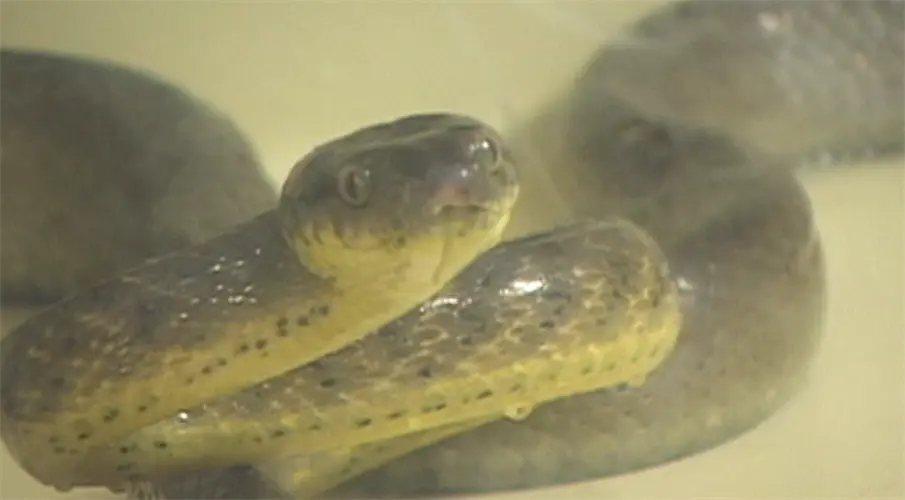
Can brown tree snakes swim to Cocos Island, where endangered ko'ko' thrive?

A popular public lecture series at the Guam Museum is putting the spotlight on Guam’s native koko bird and the threats they still face. Today’s HITA Talks - Heritage, Ideas, Traditions, and Arts – bring together conservation science and an unexpected experiment involving brown tree snakes. Rescue units responded to reports of possible distressed swimmers in Tumon Bay.
But Farron “The Guam Guy” Taijeron wasn’t in trouble. The content creator and self-professed environmental enthusiast was answering a simple question, posing, "If a snake wanted to swim to Cocos, to Dåno’ , then could it?"
That question posed from a comment on social media. From there, what Taijeron calls “an almost scientific experiment” quickly grew. Followers reached out and dropped-off brown tree snakes they found, wanting to be part of the test. In total, Taijeron conducted swimming trials with 21 snakes.
"Through various means, locations and weather conditions, I released and followed the snakes in the water," he explained.
Taijeron shared the eye-opening observations at Wednesday’s session at the Guam Museum. Some swam in the water for nearly two hours while others sank under three minutes. One snake swam more than three kilometers. (Cocos Island is just 2.4 kilometers from Malesso'.)
Videos showed snakes boarding floating objects such as a coconut and even a kayak. The findings add new context to the day’s other HITA Talks focused on the ko’ko’, Guam’s endangered rail.
Division of Acquatic and Wildlife Resources wildlife biologist Lauren Thompson shared an update on recovery efforts on Cocos Island. 26 ko’ko’ were reintroduced to the island beginning in 2010. Today, Thompson estimates between 24 and 36 birds are thriving there.
Camera monitoring has recorded something never documented before in the wild, with ko’ko’ engaging in reproductive activity.
Thompson said, "This is a really big deal to have this confirmed, happening in the wild. We think that honestly it may be the very first photographic, documented evidence of the koko breeding in the wild."
But for Taijeron, the possibility of brown tree snakes reaching the island raises new questions about protecting Guam’s wild koko. "I grew up not knowing any of our forest birds because they all died out before I realized how strange it is that we live on an amazing tropical island near the equator and there’s no birds flying around," he shared.
Guam's native birds were nearly eradicated decades ago after the invasive snakes were accidentally introduced after World War II .
"My outreach exploits are to bring attention to the issue because it’s kind of become the new norm and people just accept that snakes are normal now, and it shouldn’t be that way. We should be upset and we should be trying to do things about it," he said.
Thompson added, "Our ultimate goal is getting the birds, the ko’ko’, back on Guam itself. We feel like the lessons that we’ve learned from islan Dåno’ are a big step in that direction." She says the ongoing recovery efforts show that the birds are capable of thriving when snakes are suppressed to low levels, noting, "That’s a fantastic sign for Guam that we don’t necessarily need to wait until Guam is completely snake free, as that is going to be a huge challenge.
"As soon as we have areas that are snake suppressed and safe enough for the birds, we can start to get them back on the landscape soon."
In the meantime, Taijeron reminded the audience that snakes aren’t just a threat to wildlife, they’re a threat people feel personally, even at your most vulnerable moment. "If conservation is too academic for people, if caring about birds don’t hit enough people in the feels, then I can’t imagine a greater motivation for people to care about ridding our island of snakes than the fear of getting bit with your pants down on your toilet," he said.
For the time being, Taijeron says he humanely kills the invasive brown tree snakes after his experiments, so no worries there about live snakes being left in the ocean.