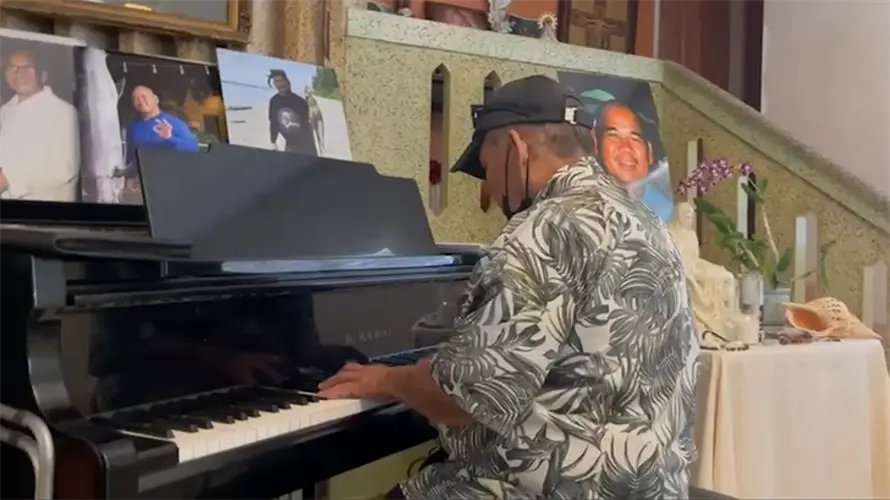
January 11, 2026 marked a heartbreaking turning point for Guam’s music community—a day when the island lost not just a musician, but a guiding force, a mentor, and a heartbeat of local sound.  Now, some who were shaped by Thomas Bejado’s music and spirit sit down with KUAM News, sharing memories and gratitude—reflecting on a legacy that continues to echo through every chord, every lyric, and every life he touched.

"Tommy is this well renowned jazz musician whose knowledge of music and cords and theory we thought exceeded our expectations," said vocalist Louise Muna. "He has arranged over 60 of my songs, original compositions I come in with my guitar, and that's all I hear. But he hears the drums,the bass, whatever instruments should go in there, whether it's a saxophone, or just strings, yup, amazing."

And percussionist Richard Arroyo added, "I call him 'The David Foster of Guam'. And if you don't know who David Foster is, he one of the greatest producers in the world has created many #1 hits. He is just really a great musician. He was so understated. Even when he's playing and his mind is like at ten different places, and his hands are still playing but his mind is going different directions, so like geniuses right."

Thomas “Tommy” Bejado, the visionary who helped give Guam its modern musical voice, died on Jan.11. He was 70.  For more than four decades, Bejado stood at the center of the island’s sound—lifting local artists, preserving Chamoru culture, and proving that world-class music could be created at home. Widely regarded as the architect of Guam’s contemporary music industry, he transformed raw talent into lasting legacy, one recording at a time.

In 1988, Bejado founded Stel Star Production Studios, opening Guam’s first state-of-the-art recording facility in Dededo. At a time when professional production required leaving the island, his studio changed everything. For the first time, Chamoru and Micronesian artists had access to high-end equipment, expert production, and the belief that their voices mattered.

Musician JJ Concepcion said he came recommended by musicians Mike  and Antoinette and gave him a call. This was in 1992. "I've got all these songs available and to be quite honest, I don't have any money, but if you could help me out, i would love to hear from you. He says you know what you can do JJ, you can record your songs on a cassette tape."

Muna added, "He said drop it off, he said write the name of the songs...that was my first time meeting him, and he's like let me listen to it."

6 days later, Bejado called Concepcion and said come to the studio and we'll talk about it. 6 CDs later, they worked together from 92 until 2001.

"I had a very good experience with Tommy. Right off the back he was willing to help me. He was very kind to me. he is definitely is genius in music," Muna said.

From that studio came albums that shaped generations. His influence reached far beyond albums and stages. Bejado’s compositions became part of Guam’s everyday rhythm through commercial jingles that defined local brands. That's where Muna recalls her initial meeting but it was when he joined the radiants 4 years ago, 

"So when Kin said im going to ask Tommy Bejado, to be our keyboard player, my sister and I were like is he gonna want to play with us little people, we call Radiants pala pala, dance, cha cha, jitterbug," she said.

"When he said yes we were surprised, and he really elevated the sound of The Radiants."

Arroyo shares when he had the chance to play alongside Bejado, he got excited. "He had produced so much music on Guam...even karoake laser disc even when I turned 18 years old at the karoake bars and it was his music his Chamorro music, and it was incredible," he said.

And Muna said that if Bejado was talking through her to the young artists, he'd say, "Never deny yourself the opportunity to share music with people, I mean that's why we're given this God-given talent, so we can share it with the people, and he gave so many people that opportunity."

And if there was anything they wished they could of let Bejado know, Muna said, "I would of appreciated him more and told him thank you for everything. For me whenever I got together I always remind him how important he was and I always make sure that he knows that. He was a big part of my life."

Tommy Bejado didn’t just produce music. He built a foundation, protected a culture, and ensured that Guam’s sound would be heard—clearly, proudly, and on its own terms Public viewing is scheduled for Saturday, Jan. 31, from 8:30 to 11 a.m. with mass at noon at St. Anthony Catholic Church, with internment at Guam Memorial Park.