Pacific Center for Island Security: “Guam is being treated like a petri dish" as missile defense plans go forward

The plan to build an estimated $8 billion missile defense system on Guam is moving forward at “breakneck speed,” according to Pacific Center for Island Security Chairman Dr. Robert Underwood. “Guam is being treated like a petri dish. If

September 12, 2025Updated: September 26, 2025
Super AdminBy Super Admin

The plan to build an estimated $8 billion missile defense system on Guam is moving forward at “breakneck speed,” according to Pacific Center for Island Security Chairman Dr. Robert Underwood. 

“Guam is being treated like a petri dish. If you can remember back to doing experiments in biology and in science, Guam is being treated like a petri dish for this Enhanced Integrated Air Missile Defense System,” said Dr. Underwood. “You can tell immediately. They’re announcing all the bids, all the bids that have come out this week, over $15 billion worth. Of course, in addition to that, there’s a number of provisions that are coming out both in Congress and the Senate Armed Services Committees and appropriation measures, that they’re going to spend a lot of money in Guam, for all the projects that they’re involved with, except the projects the people of Guam are very, very interested in.”

The Missile Defense Agency released the Record of Decision earlier this week. The system is expected to be constructed across 16 military sites to defend the island from evolving regional threats. 

But the Guam think tank is concerned the project is proceeding without a concrete plan to address major concerns from the community, like the housing crisis or a need for a civilian shelter. 

“The question is, at what point does the community make a real impact into this process? Almost everybody on Guam is concerned about housing and about shelters. The Department of Defense, now rechristened as the Department of War, is not interested in anything related to peace or security. They’re simply related to preparation for war,” added Underwood. 

Governor Lou Leon Guerrero is also dissatisfied, saying, “We are taking the MDA’s record of decision very seriously. That said, I am not satisfied that the cumulative impacts that we have identified and provided to MDA during the EIS (Environmental Impact Statement) commenting period have been addressed.”

She also disagrees with the decision not to convene an Economic Adjustment Committee, which she says would ensure “communities like Guam are not left to shoulder the burden of national defense missions alone.”

According to the EIS, about 1,000 military personnel and 1,300 dependents are expected to relocate to Guam in phases for the ten year project. 

The project would also require 400 construction workers annually, with about 60% of them expected to be migrant workers that will need housing outside the fence. 

“The housing issues are absolutely critical for not just the security of the island, but for the prosperity– for the sense of security that people have that they can own a home, that they can rent a home. What is the greatest insecurity that anyone can have? I don’t think if you walked around and asked people, what is their greatest sense of insecurity, it would be about Chinese attacks. I think the greatest sense of insecurity is about the security of their lives as families, on a day to day basis,” added Underwood. 

Underwood notes Guam's housing crisis is not unknown to military officials or to congress. 

A mandated independent report was commissioned from the Massachusetts Institute of Technology Lincoln Laboratory, but the report has yet to be disclosed to the public. 

“People need to know what they know about what they know about our housing situation and whether they are seriously studying it or not, and more importantly, are they taking any ameliorative measures to give the people on this island a sense of security about their future– about a real sense of security,” Underwood said.  

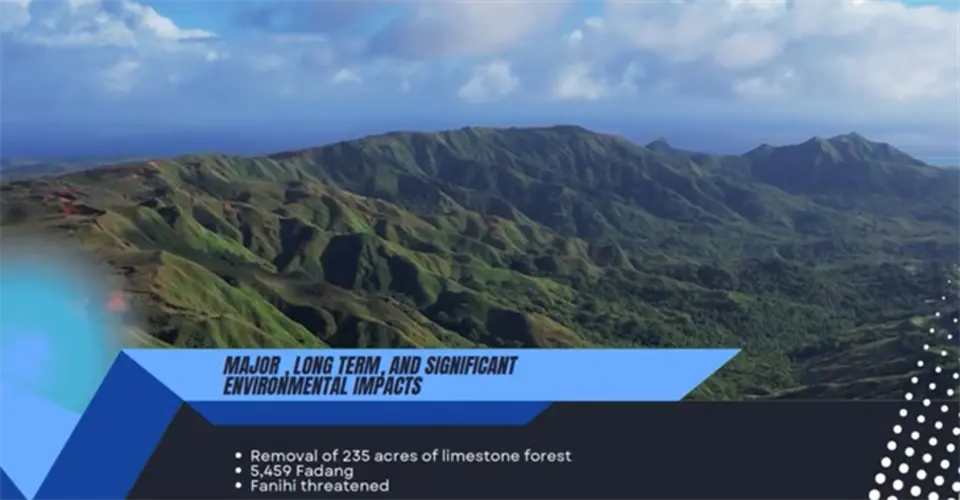
Another major area of concern as the ROD acknowledges “major, long term and significant” environmental impacts such as the “removal” of 235 acres of limestone forest habitat across nine sites, which houses Guam's native species. 

It states 5,459 of the protected Cycas Micronesica, or Fadang, will be removed, with significant impacts to the threatened Fanihi, or Mariana Fruit Bat. 

“It’s important to know there’s a word they use a lot, which is ‘mitigation.’ How do you mitigate the destruction of a limestone forest? Are you going to create a new limestone forest? How do you mitigate the destruction of reefs and how do you mitigate the destruction of native species? This plan will end the Fanihi once and for all here in Guam,” Underwood said. 

KUAM asked, “So now that they’ve already decided to move forward with this plan to construct the missile defense, what agency does Guam have to make sure that the DOD takes responsibility for this, for the impacts?”

“I think that responsibility falls on the entire political leadership of Guam. It falls on the governor’s office, it falls on the delegate’s office and it falls on the Guam legislature,” replied Underwood. “…Not just ask for it, but to absolutely put their foot down and say ‘we can’t cooperate with you anymore, we can’t collaborate with you unless these issues are addressed.’”

Meantime, the Governor says, “Guam’s security and the safety of our people remain our highest priorities, and we are committed to ensuring that this project also reflects the well-being of our island community.”