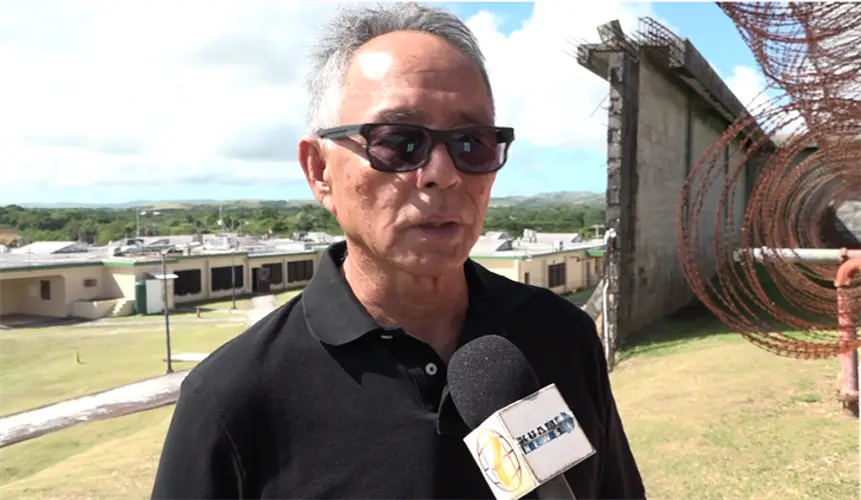
Ishizaki says improving parole system could help ease prison population
Calling conditions at the island's prisons "inhumane," the head of the Department of Corrections said he's taking a long hard look at how to reduce overcrowding - and this may lead to more convicts on parole. DOC Director Frank Ishizaki is concerned about
Calling conditions at the island's prisons "inhumane," the head of the Department of Corrections said he's taking a long hard look at how to reduce overcrowding - and this may lead to more convicts on parole.
DOC Director Frank Ishizaki is concerned about a flurry of bills coming out of the Guam Congress Hall--the bills purporting to be "tough on crime" but Ishizaki says the prison is already bursting at the seams.
"Is that what we want to do is just lock people up," he questioned. "Are there other solutions? I think as a community we should engage in that conversation."
Looking at ways to cut the population at the Mangilao prison and the Hagatna lockup, and he says inmate and detainee levels haven't been this high since the prison housed illegal immigrants from China years ago.
The director says more needs to be done to increase the number of convicts on parole and that could help alleviate crowded conditions.
"With parole, that's another opportunity for people to live outside of prison and have an opportunity to prove that they can live out there without making trouble," he said.
Ishizaki tells us the prison is going to be working on figuring out how many inmates would meet criteria making them eligible for parole
"Low-risk convicts," he said. "The courts have a risk assessment tool. We're not using it and we're going to be using it, so we need to assess every convict we have and see if we can put them out."
But Ishizaki says DOC's parolees don't have a good track record.
"Our parolees are not as successful," he said.
But he said that parolees' lack of success is because of the government's failure. He said DOC has continually been shortchanged on its budget for years - meaning the prison has to do a whole lot more with a whole lot less.
"We don't have programs to get them prepared for release and the other one is we don't have parole officers to supervise them," he said.
The director said there are currently five parole officers at DOC. He is in the process of hiring two more, but he says in a perfect world - he would hire 10 more.
Ishizaki also says with a lack of supervision while on parole after serving time, the big brother relationship PO's should have with parolees is nonexistent.
"You got to be home before curfew, you go to be looking for work, you got to be at work," he said. "Don't hang out with the people that got you in trouble and don't mess with drugs or alcohol - kind of general release conditions of release. And so big brother is that parole officer who's going to try to keep you on the straight and narrow. And if we don't have that parole officer out there then the chances of you straying from that narrow line is greater."
Ishizaki also plans to work with the judiciary to reduce overcrowding - since half of DOC's population is pre-trial detainees.

By KUAM News