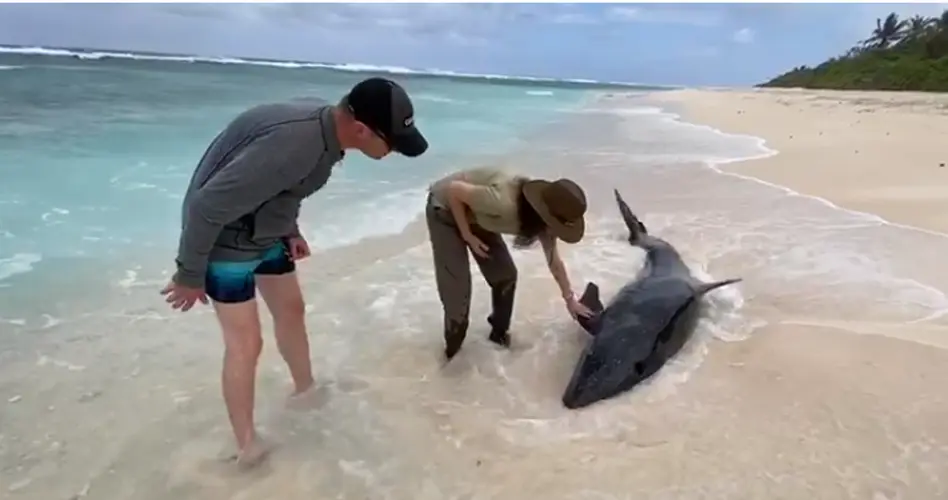
Whale stranded at Ritidian pushed back out to sea

The pictures and videos made the rounds Wednesday. A False Killer Whale beached at the Ritidian Wildlife Refuge. Brent Tibbats from the Department of Agriculture told KUAM that refuge staff was able to push the whale back out to sea, but that doesn't mean

January 9, 2020Updated: January 16, 2020
KUAM NewsBy KUAM News

The pictures and videos made the rounds Wednesday. A False Killer Whale beached at the Ritidian Wildlife Refuge. Brent Tibbats from the Department of Agriculture told KUAM that refuge staff was able to push the whale back out to sea, but that doesn't mean it's the end of the tale.

Refuge staff, Andersen Air Force Marine Patrol and Tibbats surveyed the shores this morning to see if the whale beached itself again.


"So between all these surveys, we did not see any sign of the whale again this morning so it did not strand in those areas," he said. "There's still a potential it could re-strand somewhere else on Guam or on these beaches the next several days so we'd ask that if people do keep an eye for it and if they do see it please notify us right away."

We asked Tibatts, a fisheries biologist, why he thought this whale beached itself.

"It's hard to say without having a specimen on hand," he said. "There are certainly diseases whales get. There are environmental causes; there can be in some instances it is thought that maybe sonar can cause stranding. Some things like that, but really it's almost impossible to tell without having specimens in hand what the cause is."

Tibbats also said this was the second whale stranded in as many weeks, while the whale stranded at Ritidian was pushed out to sea, a whale stranded in Rota was not so lucky.


"Having two in the same part of the world this close together is a bit of interest and so we're trying to figure out what we can find out about that and the people at the whale lab in Hawaii are interested as well," he said. 

We asked Tibbats if he thought the military's use of sonar was a factor in the whale stranding


"I'm not aware of any military activity going on in the area right now, so that's not number one on my list, but you can't exclude it," he said. "But it wouldn't be number one on my list. But it is interesting that two of these stranded within a couple weeks of each other."

Tibbats said the beached whale may have been part of a pod sighted near Facpi Point in the last week.

About a year ago, a beaked whale washed ashore in Agat, and Tibbats said he's still waiting for test results to find out how that whale died.


"To see if it is sonar related or something like that, generally the ear bones are the most useful tissue sample or organ sample for that," he said. "Pretty much there's only one person in the world who deals with those and I believe he's in Germany and those were sampled but we haven't gotten any results back on that and it's not clear when we will hear results on that."

We asked Tibbats what you should do if you come across a stranded whale.


"Please do not approach it for one thing even though they may be weak it's like they're very, very strong and they can still inflict a lot of damage if they do decide to react," he said. "Also whales can transmit diseases to people so we want to make sure no one catches anything from whales, especially if you're in touch with whale body fluids and blood."

Tibbats said you can call the Division of Aquatic and Wildlife resources if you see a stranded whale. The conservation hotline is 864-DAWR. You can also call 735-0281 or 89 or the Guam Police Department at 472-8911. 

Tibbats said over the last 40 years, Guam has averaged two stranded whales a year.