Insight into ancient Chamorro life discovered

A new archaeological discovery on the eastern end of Ritidian gives us a glimpse into the life of the ancient Chamorros.

July 3, 2015Updated: July 3, 2015
KUAM NewsBy KUAM News

A new archaeological discovery on the eastern end of Ritidian gives us a glimpse into the life of the ancient Chamorros. Dr. Michael Carson, an archaeologist with the University of Guam, made the discovery last fall.

"I was with Brian Leon Guerrero, a maintenance worker at the Wildlife Refuge, and he was very interested in the archaeology of this part of the refuge in particular," Dr. Carson said.

Both men ventured to the eastern end of Ritidian, where they made the discovery of a lifetime. "Within a few hours we were clearing off the vegetation and finding the remains of an entire village just sitting there neglected for many, many years," he added.

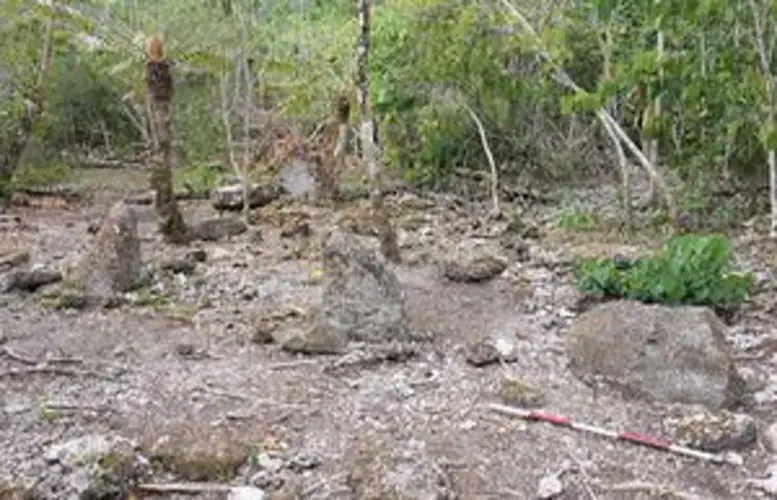
Amidst the jungle foliage was a completely intact ancient Chamorro village, consisting of approximately 15 latte stone homes. Carson said the natural setting makes it feel as if you are actually walking through the village, adding, "That makes you wonder what it was like to live there. These people must have known each other, did they have certain kinds of relations and activities that they did together we can see some of the remnants of those activities in the archaeological remains."

Pottery, patches of burned soil, fishing hooks, beads and porcelain introduced by the Spaniards were all discovered at the site. Dr. James Bayman from the University of Hawaii is working with Dr. Carson, and says these artifacts provide insight into Chamorro society.

"It looks like one of the latte was used predominantly for activities that young women participated in, activities such as cooking and other related activities. The other latte was a focus of male activity," he explained.

Doctors Carson and Bayman are working collaboratively with the US Fish and Wildlife Service, the Guam Historic Preservation Office, and scholars from throughout the region. "At this stage we have finished the identification of finding everything in the jungle and clearing, documenting, mapping precisely where everything is, and conducted some very limited test excavations," said Carson.

While radiocarbon dating analysis has yet to be completed, the village is estimated to date back hundreds of years. Bayman pointed out, "What we see on the surface is all related to the last time people were living at the village, and we've pinpointed that in the late 1600's, which would be the Spanish Chamorro contact."

But under the surface, Carson says the entire span of the Chamorro settlement in Guam is represented, leaving much to learn about the history of the Chamorro people.

It is also important to note that the preferred site for the proposed military training range may encompass part of the Wildlife Refuge - the area where the latte village was discovered.