Legislation in favor of waste-to-energy shot down

Following a lengthy public hearing, the waste-to-energy saga will continue as a bill approving the project was shot down.

December 12, 2014Updated: December 12, 2014
KUAM NewsBy KUAM News
by Ken Quintanilla

Guam - It's another chapter in the long saga over a waste-to-energy facility that not only has spanned over a decade but several administrations, legislatures and attorneys general. And following a very lengthy and inquisitive public hearing it appears the saga will have to continue as the bill approving the project was shot down this afternoon.

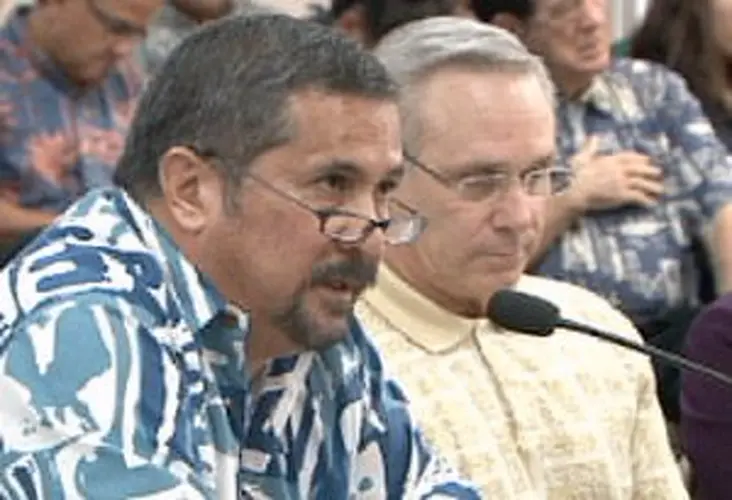
It was a packed house at the Guam Legislature throughout the day and all for good reason: discussion on the proposal for a waste-to-energy facility. Senator Tina Muna Barnes via Skype said, "This is not a new issue; it has been discussed publically in one form or another in the last 14 years." It was last week when Senator Barnes introduced Bill 433 that would ratify the settlement agreement between the Government of Guam, GEDA and Guam Resource Recovery Partners and approve the waste-to-energy project. Today, a public hearing was held on the decades-old issue attracting both its biggest supporters and of course, its strongest critics.

Chief Deputy Attorney General Phil Tydingco was the first to testify commenting on the legal issues of the bill, saying "We believe this bill attempts or purports to ratify a settlement agreement and approve a contract we believe that is a violation of the separation of powers doctrine, it's unconstitutional and inorganic."

He told lawmakers the language is not only ambiguous, confusing and appears to create a monopoly, but also circumvents the procurement law and overrides some of the law in the books including the anti-incinerator bill. GRRP attorney Anita Arriola however disagreed, saying, "These are non issues because the court has already decided them and they are binding on the Government of Guam."

She says this current contract attached to Bill 433 is product of mediation between the government, GEDA and GRRP. As a result of that mediation, the parties entered into an MOU settling a lawsuit and claims between the parties. She says the parties successfully negotiated a new WTE contract on terms more favorable to the government than the 1996 contract. She further addressed two major issues that the opposition has raised recently, saying, "What the GRRP contract does not do is it does not kill the recycling industry as some have stated the WTF facility does not conflict with recycling because it does not burn glass, metals or aluminum cans and will not receive office paper or cardboard."

She adds the WTE facility cannot stand alone and needs the recycling industry in order to have an integrated approach to solid waste management in Guam. "Contrary to the statements by the receiver David Manning, this contract will not bankrupt the Government of Guam," Arriola stated. "That's an irresponsible and reckless statement made by a person whose financial interest you should consider and the source of his statements."

She ultimately says what GRRP offers is a "cost-effective solution to solid waste management in our island that will result in clean renewable energy."

Ken Ormsbee in the meantime also testified his support on the project. Ormsbee is the senior vice president of Energy Systems Group but first became involved with GRRP back in 2007 when the business he led was still owned by Chevron Corporation which was previously named as the funding partner on the project. "You might wonder why we're still around when this project outlast Chevron's ownership of his business. The answer the pretty straightforward and simple - this is the best project that I've been involved with the merits of it in my entire career and it really does illustrate what the definition of what sustainability is," he said.

Others like Consolidated Commission on Utilities chairman Simon Sanchez in the meantime says one of the problems in the contract is it lacks all the details you would see in a power purchase agreements that GPA has signed with other developers, noting, "The Guam Power Authority and John Benavente's position is this contract would cost the people between $11 million and $21 million a year depending on the size of the plan."

Sanchez is also a co-owner of Guahan Waste Control which has been a major opponent of the WTE project. And while GRRP has stated the project makes sense environmentally and economically, Sanchez disagrees. "How can a senator in good faith act on this bill, with the risk that you're going to impart on the people of Guam $11 million $21 million a year of further obligation for the next 20 years it would be irresponsible in my view," he said.

i-Recycle program administrator Peggy Denney in the meantime says the bill raises more questions than actual solutions, saying, "My attendance here is as usual to promote aggressive waste reduction, to promote active reuse of things that can be reused and aggressive recycling I'm not sure that's going to take place with this proposed legislation and this proposed facility."

The governor's legal counsel Sandra Miller meanwhile offered the Government of Guam's position on whether it has vetted this contract fully and if its in the best interest of the people. "It has always been the government's position that provided that the project and the contract is legal, and that it is environmentally sound and that it is financially viable that the government would have no objection to it so there are a number of criteria that need to be met before anything can even happen," she said.

With so many questions over the bill, oversight chair Senator Dennis Rodriguez Jr. ultimately decided he would not report the bill out of committee nor would he move forward with the bill in this legislative term.