First responders trained to handle Ebola

Local first responders are being trained to prevent the same from happening here on Guam should the deadly disease find its way to the island.

November 3, 2014Updated: November 3, 2014
KUAM NewsBy KUAM News
 by Krystal Paco

Guam - With recent reports of stateside healthcare providers contracting the Ebola virus, local first responders are being trained to prevent the same from happening here on Guam should the deadly disease find its way to the island.

Although unlikely, should a suspected case of Ebola find its way to Guam, officials are getting trained and ready.

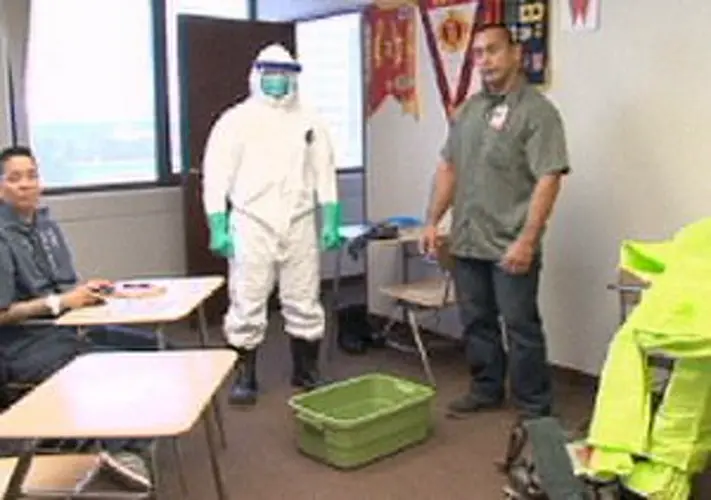
From the first 911 call to transport - Fire Captain Daren Burrier covered CDC recommendations on how to handle a suspected case or person under investigation at training held on Friday.

These measures include identifying exposure history, identifying signs and symptoms, isolating and determining personal protective equipment needed, providing information to healthcare staff, and further evaluation and management.

But most important of all - not to cause panic. :"A lot of people get scared. Because they have a fever, they're vomiting. They have diarrhea. Do they have Ebola? If they haven't traveled from Sierra Leone or Nigeria or Guinea, they probably do not have Ebola," he said.

In fact, with the length of time it takes to travel from any one of the Ebola infected areas to our island in the pacific, the individual should already be showing symptoms of the virus and would likely be flagged at any other stops prior to making it to Guam.

But why is the disease spreading so rapidly in these countries and why so fatal? "The main thing that's causing the spread in West Africa is that their customs and rituals in how they treat their dead. That came out in the news the other day saying that when someone in their family dies, they wash their bodies, they hug their family hey kiss their family they get in complete contact with the bodies," he said.

In the event Ebola does find its way to Guam shores, burrier explains not all ambulances and medics will need the protective gear. One ambulance has been dedicated for transport. Should there be more than one patient, another ambulance can be outfitted in 30 minutes. As for hazmat suits, responders will always work in a buddy system and be monitored for proper donning and doffing of the suits as cross contamination is suspected to have resulted in stateside cases in which nurses contracted the disease.

"The general belief that the fact that when they doffed and donned their PPE's they did it in the wrong way and it cross contaminated with their skin and they got infected," he said.

On the receiving end, Guam Memorial Hospital and Naval Hospital both have designated areas for isolation.

The recent training is just one of many Ebola virus disease trainings. Another is slated for November 24.