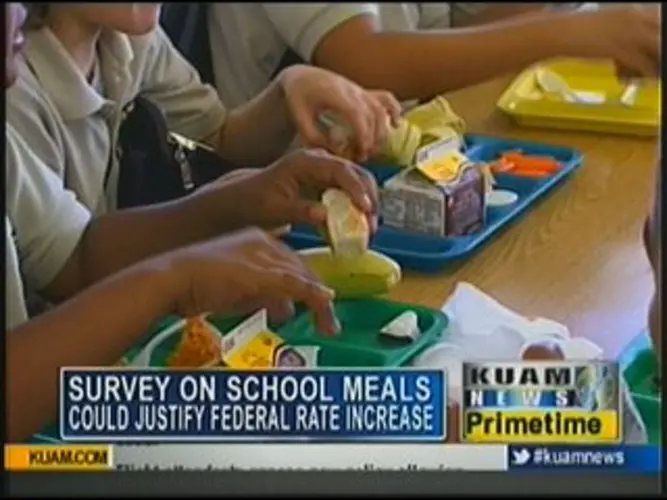
Guam public school lunches cost 3x more than in mainland

Thousands of the island's school children eat breakfast and lunch in the school cafeteria, but how much does it cost to feed them?

April 3, 2013Updated: April 3, 2013
KUAM NewsBy KUAM News

by Krystal Paco

Guam - Thousands of the island's school children eat breakfast and lunch in the school cafeteria, but how much does it cost to feed them? A single red apple may cost $0.08 in the U.S. mainland but here at home, it's $0.28. A half-pint of California sunshine milk $0.16, here at home, $0.56.

DOE federal programs administrator Ike Santos says the difference in prices, mainly due to transportation costs, means it costs more to prepare a school meal here on Guam than it does for a student in the state of Iowa. But what's really hurting local taxpayers? Santos says federal counterparts consider Guam as a contiguous state, unlike Alaska and Hawaii. This directly affects the amount of federal reimbursement the island receives prompting the ongoing 2013 School Lunch and Breakfast Cost Study - a $200,000 study to be conducted by the University of Guam's Cooperative Extension Services.

Extension agent and program leader Peter Barcinas said, "This is one of those areas where the food costs for schools is always a continuing concern as to how is it being funded, what share is coming from the local government and what share for the most part is being reimbursed through federal grants."

CES enumerators are going village-to-village through the month of May to get information from a minimum of 500 households relative to household expenditures and the number of children receiving free or reduced meals. If successful, the study could help Guam could justify a need for more federal reimbursement dollars for school meals.

"If DOE is entitled to a rate increase, than this is part of that required step. To conduct the study and make the case for the rate increase," added Barcinas. "Guam is further than the states from Hawaii and definitely cost issues if transportation is a key factor then what percent of that is reflected in terms of a price increase."

DOE received close to $8 million last year in federal reimbursement that's divvied up not only among DOE schools, but the Department of Youth Affairs, childcare providers, private schools, and DoDEA. Santos says if a rate increase is justified, Guam could see at least a $2 million increase annually in federal reimbursements.

For more information on the survey or to sign up as an enumerator, call 735-2057.