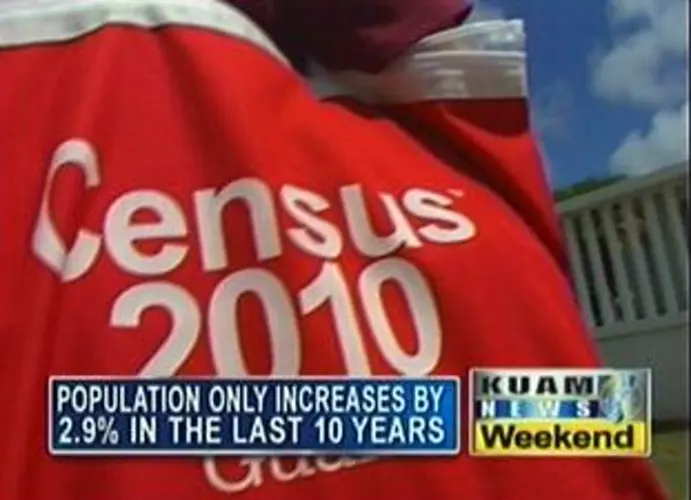
Island population only increased 2.9% in last decade
While officials had pegged the population to be in excess of 180,000 people, the 2010 Census results show considerably less growth and it could be because more island residents have chosen to relocate to the U.S. mainland.
by Mindy Aguon
Guam - Between the 2000 and the 2010 Censuses, Guam's population only saw a slight increase in population. While officials had pegged the population to be in excess of 180,000 people, the 2010 Census results show considerably less growth and it could be because more island residents have chosen to relocate to the U.S. mainland.
Migration of Guamanians to the States may have played a huge factor in the rather low figures that were recently released. Bureau of Statistics & Planning director Tommy Morrison says officials had projected that Guam's population had increased to 180,000 people. Instead, the territory fell far short - the 2010 Census pegged our population at 159,358. That's a 2.9% increase from the 2000 Census population of 154,805.
Morrison said, "Based on the American Community Survey from 2006-2010, it shows that around 21,000 Guamanians entered the U.S. So that's something that is a factor."
But with an estimated 3,000 new babies born every year, over a ten-year span that would be an additional 30,000 added to Guam's population. When the numbers don't jive or officials have concerns about the count, a census count resolution can be requested.
In Guam's case, however, one isn't eligible.
Morrison says the census bureau provides an alternative, telling KUAM News, "There is a last phase on Guam through our local representatives that handles that phase and it takes the part of the phase of the count resolution. That's made up of the mayors, the utility agencies and land management and many of the agencies that took part and they validated this results and sent it off to the census bureau for processing."
Morrison adds that underreporting has always been an issue and a concern but he doesn't believe that was the case for the 2010 Census, as there's nothing to validate that claim.
He notes that Guam did see a 2.9% increase in its population while some jurisdictions didn't see any increase. Additionally, the territory also saw an increase in census designated places (CDPs), which Morrison says allows for more federal opportunities at the village level.
He added, "So it opens up for specific areas within the villages, transportation, housing the ability to build potentially more schools. But that data is available and we saw an increase from 37 to 57 census designated places."

By KUAM News