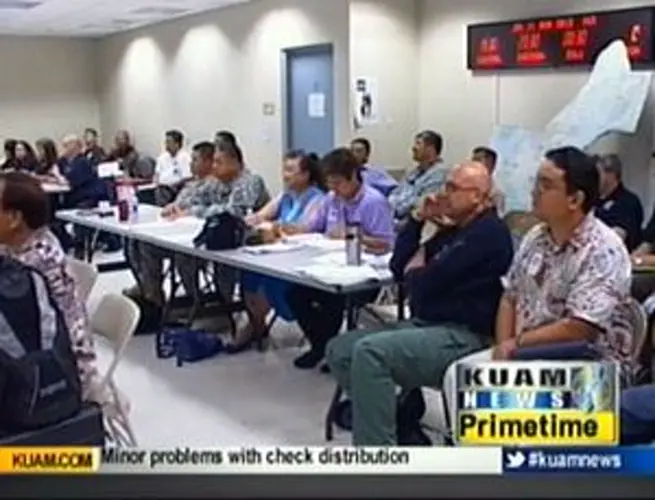
Responders practice typhoon preparedness

Guam Homeland Security/Office of Civil Defense is partnering up with various government, private and military agencies to conduct the Typhoon "Pakyo" Exercise 2012.

June 11, 2012Updated: June 11, 2012
KUAM NewsBy KUAM News

by Tanna Tarpley

Guam - Guam Homeland Security/Office of Civil Defense is partnering up with various government, private and military agencies to conduct the Typhoon "Pakyo" Exercise 2012.

While the National Weather Service reports a 50/50 chance Guam will be hit by a typhoon this year, officials are revving up their skills and preparedness with Typhoon Pakyo Exercise 2012. The two-day training is to help prepare Guam for any incident or emergency in cases of a Category 4 or 5 typhoon or any other possibly catastrophic event.

Mike Karl is FEMA's Region IX federal coordinating officer, and said, "We participate annually in these exercises and this year we have a rather robust team out here because there's been some new, turnover, in talent here in Guam and we want to make sure that we can work with them meet that we could the needs of the governor, the citizens and the survivors of any event."

According to external affairs director John Hamil, the Pakyo exercise is necessary for all agencies involved to observe each others skill sets in order to fix any possible gaps in Guam's current emergency and incident plans.  "We say in FEMA, we don't like to exchange business cards at the scene of a disaster you know you want to come ready in the island communities of the pacific it's very important to have personal relationships with people ahead of the need to use them," he said.

"The exercise is to help validate Guam's current emergency response plan to catastrophic events that may impact the island."

Critical to the emergency response plan is the Department of Education. Island schools are used as emergency shelters, providing a safe haven for island residents who don't have a place to ride out a storm.

According to DOE safety administrator Bruce Williams, new statistics show that up to 10,000 residents may need shelter when the next major storm hits Guam. "In the past its been just the schools but we're trying to get everybody on board as far as getting trained to run shelters and we're looking at opening other shelters besides schools because that's what we're going to have to do should we get a big storm come our way," he said.

Additionally, Guam's responders are looking to incorporate transitional shelters for evacuees for after the storm. The training continues tomorrow at the Emergency Operations Center in Agana Heights.