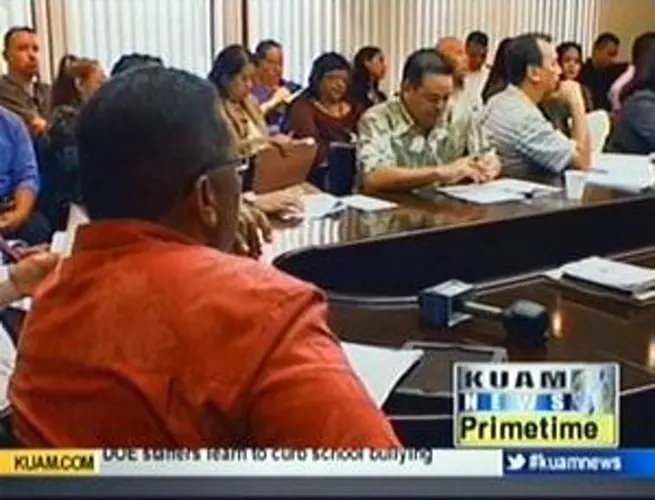
Guam - As they wait to hear back from the ratings agencies relative to achieving the Series "B" bonds, nearly three dozen people met today to hear the Calvo Administration's plans in ensuring a path is set to fix the structural imbalance of the government. The Fiscal Responsibility and Tax Refund Commission met for the second time to formally present Adelup's Deficit Reduction and Fiscal Reform Plan.

According to GEDA administrator Karl Pangelinan, the report, which is in response to public law, provides a snapshot of issues ranging from expenditure patterns and revenue collections to unfunded mandates of the federal government. "It's kind of a variation of a playbook and I think it's a lot of relative information and a lot of information we use and recommendations we can use moving forward to address this deficit," he said.

These recommendations deal with eliminating such a deficit to pay for tax refunds in a timely manner along with making tough decisions in order to begin budgeting properly. BBMR director John Rios meanwhile says the report was information but also addressed how to possibly reduce the deficit. He said, "That they understand that we're trying to show some fiscal discipline and control spending, and if you look at some of the revenue projects that we showed in the report, we showed a growth rate of 2%, and that's being very conservative."

Vice chair of the commission Vice Speaker B.J. Cruz stressed reiterated the need to ensure that all fees are collected appropriately to possibly offset costs and had concerns relative to qualifying certificates and the governor's cost-cutting measures. "And I implore you to really look at that bleeding out (of the General Fund) before we start talking about laying-off people, I cannot overemphasis that has to be absolutely the last, last thing we do," he said.

Minority Leader Frank Blas Jr. meanwhile questions whether the government would be in its current position if we were properly reimbursed for costs relative to Compact impacts. He says his research has shown nearly $600 million and when added with unfunded federal mandates totals at over $1.2 billion, which is a bit more than the current deficit. "No other state in the nation would tolerate the treatment of not being reimbursed properly for these services, and I'm glad to see that it was the sentiment of the Commission to move forward of possibly taking some legal action to be able to look at recouping some of this," he said.

The Commission accepted the report where it will then be transmitted to the Guam Legislature. The report is a component of the Fiscal Stabilization and Sustainability Plan that the Commission is currently working on and expects to be completed in the next month or two.