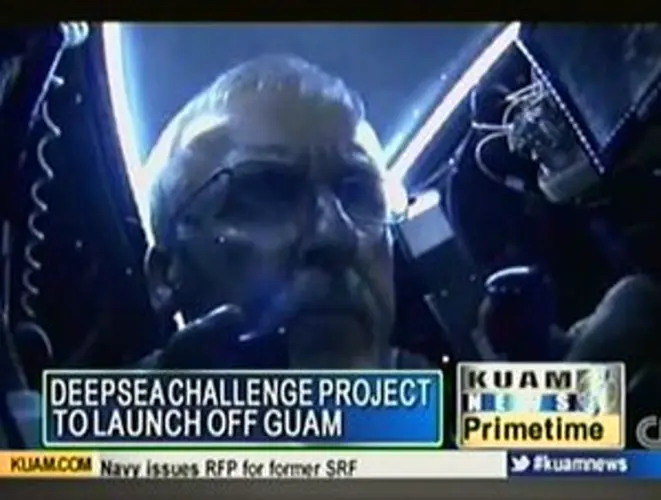
Project journeys to the bottom of the Marianas Trench
It's a significant undertaking that brings scientists from all over the world to the territory preparing to research and explore what exactly is at the bottom of the world's deepest point on Earth.
Guam - By the end of the week, the DeepSea Challenge Project will launch off Guam. It's a significant undertaking that brings scientists from all over the world to the territory preparing to research and explore what exactly is at the bottom of the world's deepest point on Earth.
He's been behind the camera of some of the biggest blockbusters ever, but filmmaker James Cameron is playing a leading role in the Deepsea Challenge Project, a joint venture of the National Geographic Society and Rolex to conduct deep-ocean research and exploration into the Marianas Trench. "There's really a lot going on down there than we ever thought before," he said.
Senior development engineer at the Scripps Institution of Oceanagraphy Kevin Hardy is part of the expedition team assembling in Guam preparing for Cameron's dive into the unknown. He said, "Jim has actually assembled quite an array of scientific talent from around the planet we have patty friar from university of Hawaii who actually found the Sirena Deep in 1997. Her group we have folks from JPL Jet Propulsion Lab who are interested in life on other planets the oceans of the moon of the outer solar system like Europa, for example. He's here to learn about clues that can be found there the Scripps guys of course are here doing there biological research624 so we have quite a few partners from around the planet."
According to Hardy, Cameron who is also a National Geographic explorer in-residence, will deploy into the trench in a submarine he co-designed. He will be trailed by two unmanned vehicles, one that will film Cameron's descent and time at world's deepest point and another that will collect samples for research in marine biology, microbiology, astrobiology, marine geology and geophysics. "So the project is both film and science," he said.
Playing a supporting role, the University of Guam Marine Lab, associate professor of marine biology Dr. Laurie Raymundo. She said, "Primarily, UOG is providing logistical support as we've done in the past for Scripps Institution of Oceanography. So we're the kind of launching some of their stuff from these guys right here are putting together some of the remotely controlled vehicles that are going to go down to the Trench. We really could not have done this without their help."
Cameron is not yet on Guam, but the expedition team is scheduled to head out by the end of the week. "I think his main goal is just the adventure 109 just going some place where no one else has ever been before," said Raymundo.

By KUAM News