Age of Austerity

It will be in December when the Joint Select Committee on deficit reduction will issue formal recommendations on how to reduce the nation's deficit by at least $1.5 trillion over the next decade. 

October 28, 2011Updated: October 28, 2011
KUAM NewsBy KUAM News

Guam - It will be in December when the Joint Select Committee on deficit reduction will issue formal recommendations on how to reduce the nation's deficit by at least $1.5 trillion over the next decade. Every agency is expected to take a cut including the Department of Defense currently exploring ways to cut more than $400 billion. 

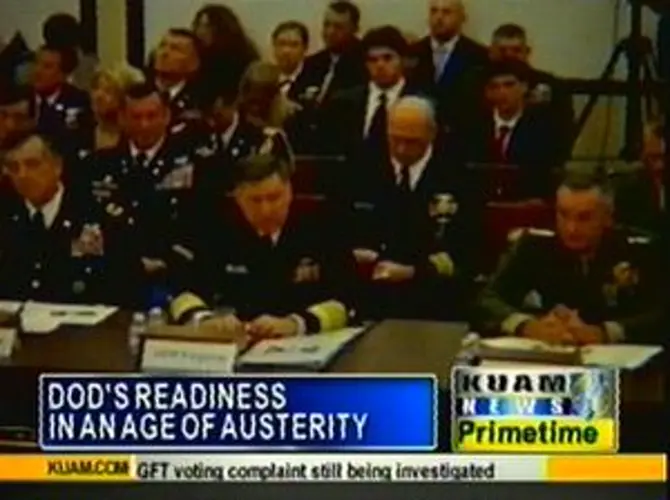
Today in the nation's capitol the house Armed Services Committee, Subcommittee on Readiness heard from the vice chiefs of the various branches of the armed services on readiness in the age of austerity. 
 
The DOD suiting up for a much different fight - the battle over the budget and ways to come up with nearly a half-trillion dollars worth of cuts over the next ten years. Appearing before the House Armed Services Committee Subcommittee on Readiness the vice chief of the various branches of the armed services testifying and answering questions on readiness in the age of austerity. During the hearing Guam Delegate Madeline Bordallo, who is the ranking member of the Subcommittee, inquired about the possible reduction in force considered by NAVFAC Marianas and the possible deactivation of two Seabee battalions. 

Vice Chief of Naval Operations Admiral Mark Ferguson III, said, "We had to take reductions in certain elements and capacities across the force in order to meet the budget targets that we had and we looked at that area of the Seabees in particular as a potential reduction."
 
While no final decisions have been made and won't be until December. During today's hearing what was made crystal clear: "physical presence matters."
 
It's a presence that should be maintained in our region. Hawaii Congresswoman Colleen Habanusa questioning assistant commandant of the U.S. Marine Corps, General Joseph Dunford, Jr. said, "If you had a magic wand where would you put your resources?" to which he said, "Congresswoman, I think its pretty clear to all of us its certainly been stated by the secretary of defense, the Pacific is the future of our country. From both the economic and military perspective, that's the number one priority."
 
But powering up the Pacific hasn't exactly been a priority for the Senate, as discussions amongst members have been geared toward reducing the military's forward deployed forces and forward based troops and returning them to the U.S. mainland. General Dunford said a decision like that would be a detriment to the defense and interests of America and its allies. And would further hamper the military's ability to respond to crises. 

He provided this example to the panel, saying, "If you took the 3rd Marine Expeditionary Force that is currently located in mainland Japan in Okinawa and soon to have elements in Guam, if you took that force and move them back to the Continental United States. In the event of a crises or contingency chairman it would take months to  move that force out to the Western Pacific and seven consecutive miracles in terms of synchronizing the planes trains and automobiles associated with moving that force."
 
Congresswoman Bordallo who has been critical of positions taken by members of the Senate Armed Services Committee regarding proposals to draw down the U.S.'s forward presence in the Asia-Pacific region, and globally, as a way to reduce federal spending says she will continue to work with her colleagues and the DOD to ensure the military has the resources it needs. 
 
"I live there, that's my home. And I wanna know that we Americans living in Guam and other islands surrounding us are protected," said Bordallo.