Can Guam afford Calvo's bond proposal?
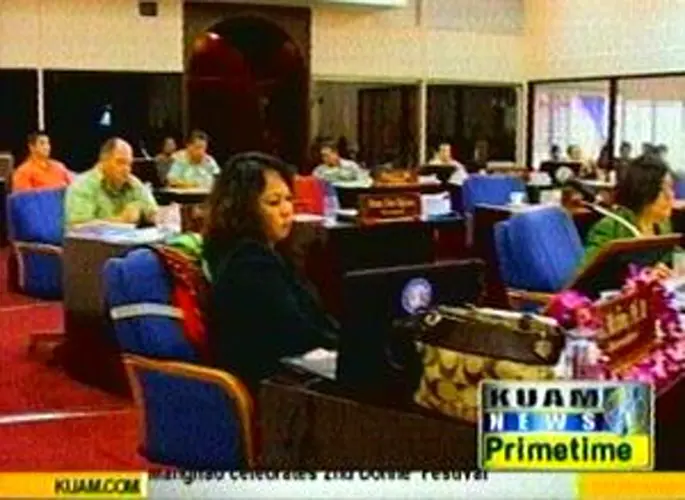
The governor's fiscal policy team returned to their seats before the Guam Legislature today for special session trying to garner their support to pass Bill 1-3-S, proposing a $343 million bond to pay out all past due tax refunds and COLA.
Guam - The governor's fiscal policy team returned to their seats before the Guam Legislature today for special session trying to garner their support to pass Bill 1-3-S, proposing a $343 million bond to pay out all past due tax refunds and COLA. The fiscal team answered questions as to whether the government can afford borrowing all the way up to its debt ceiling and meet the $20+ million in debt service over the next 30 years.
The governor's chief fiscal policy advisor, Bernie Artero, maintains the $343 million bond is part of a package that includes a fiscal stabilization plan, but the Democrats said they needed some hard numbers to back that plan up.
"When will we know that?", asked Senator Ben Pangelinan, to which Arter replied, "The affordability of the bond was contingent on two scenarios - you asked to see a ten-year projection and so we did that and it showed we can maintain that and where you see the negatives in the later years in 2020 and 2021. I did mention hopefully in place will be all these initiatives, but the other option was just looking at the roll off of the debt service that will expire or mature before the actual debt service begins for the bond. What that leaves us with is funding $8.5 million to afford the bond.
"As you know, organic growth in ranges from $20-30 million a year; I'm sure that in that scenario we could come up with the $8.5 million."
Speaker Judi Won Pat said, "We need something more concrete than what you're telling us, and I don't know, Mr. Chairman we're seeing this stabilization plan I like to see something more concrete than this. I'd like to see some numbers applied to this I wanna see whether in the bond covenant that there are going to be these measures in that will be in there to tie this government to doing this. I was here when we borrowed $204 million and $112 million went for tax refunds and John you were here and you told us to allow us to borrow this so we won't be down this road again and we're down this road again two years later."
John Camacho from the Department of Revenue & Taxation said, "Madam Speaker, we were borrowing but weren't borrowing to pay off everything. That's the difference between now what we wanna do here is borrow to pay off all prior year and moving entertain future taxes that's what we're tying to do here."
According to Senator Tony Ada, he believes paying it all off now would be better than paying a portion through Senator Pangelinan's $180 million bond proposal, of which $120 million would go to pay past due tax refunds. Ada said, "Now that debt service is about $12.4 million and that would only take care of a portion of what is past due. So what is past due the remaining past due now will still have to paid annually or monthly we still have to make out past due tax returns every month for what is past due…so essentially we can be paying more than what the $25 million debt service would be if we were to pay out all the past due tax refunds?"
"That's correct," Artero responded.
The bottom line, according to Artero, is that the bond is critical in getting the government's finances back in order. "This is an existing debt we're moving the debt from the taxpayers to a bank, and to consider lets just continue owing the taxpayer. I don't think that's correct either. And as far as my areas of concern in finalizing, we cannot stabilize this government with this big debt on our back. I keep saying it's part of a package," she explained.
Meanwhile, when lawmakers returned from their lunch break, Vice Speaker B.J. Cruz introduced an amendment to use a portion of the bond proceeds to pay past due contributions to the Government of Guam Retirement Fund. It was earlier this week Retirement Fund Board Chair Joe T. San Agustin wrote a letter to both the Legislature and governor concerning how amidst all the budget bills being entertained, none included provisions to address outstanding employer and employee contributions.
The Retirement Fund warned that should a bond measure be passed, which does not adequately pay down the outstanding contributions plus interest, the Fund will contend that the Health Insurance Bailout Agreement of Fiscal Year 2011 has been breached.
The Cruz amendment ultimately passed.

By KUAM News