Bill clarifies accessibility policy

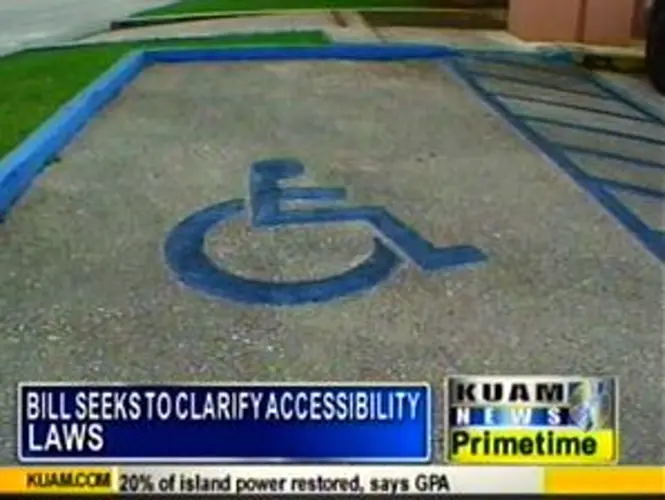
For most of us it's a minor gripe, but for the island's disabled accessibility laws can be a major headache. We do it every day and usually don't give it a second thought.  But for people with disabilities, parking can be a day-to-day challenge.

November 4, 2010Updated: November 4, 2010
KUAM NewsBy KUAM News

by Janjeera Hail

Guam - For most of us it's a minor gripe, but for the island's disabled accessibility laws can be a major headache. We do it every day and usually don't give it a second thought.  But for people with disabilities, parking can be a day-to-day challenge. 

Parking lots everywhere have accessible parking spaces, but what if you forgot your accessible access placard? Or if you have one but you don't get out of the car? And what about that space in between

"What we want to do is help the community understand that and I think that would reduce the number of violators and as a result people with disabilities would find their lives much easier when they go out by just being able to park in these spaces," said Roland Taimanglo. He's been working with Senator Judi Guthertz to draft legislation to address these issues.  Introduced last week, Bill 486 seeks to clarify the current law and educate the public using funds from the Accessible Parking Fund.  "The current law is a good law but like everything else it needs to be improved and I think now is the right time for it to be improved," he added.

Taimanglo knows from experience why the law needs to be changed. While he is independent, he needs extra space to get in and out of his car and he's had to wait for hours when other people with disabilities mistakenly park in the accessibility aisle. "There's no language in the current law that prohibits these people with placards from parking in such areas, so what happens is Roland Taimanglo has to wait two to three hours for Joe Parking to come out and remove his car and those are real life experiences I have had and others have had," he said.

Taimanglo worked with law enforcement, legislators, and others with disabilities to draft the best law possible.  But its success must be a community effort.  "We have to respect each other," he asserted. "That means that both people with disabilities have to be responsible and also those people without disabilities. We both have responsibilities."