by Krystal Paco
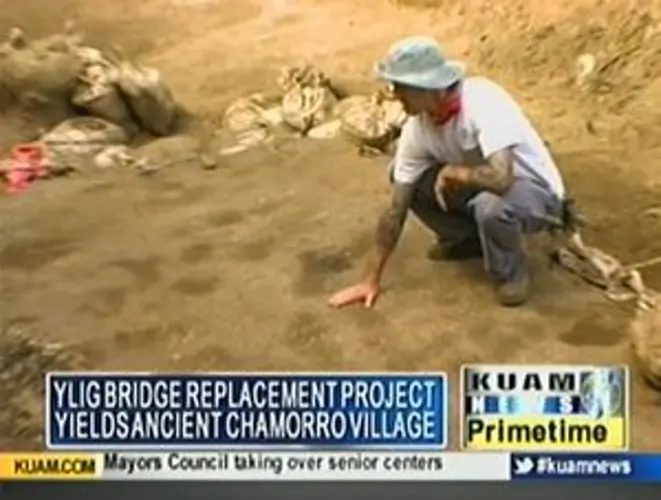
Guam - The Ylig Bridge Replacement Project may have started in November 2010, but archeologists are now beginning to uncover remnants of a Latte Period village along the site. The update to the bridge may have opened a gateway to the island's history some 500 years ago.
It's the first of its kind and likely proof that ancient Chamorros had other forms of homes. International Archeological Research Institute, Inc.'s senior archeologist and project manager Tim Wreath told KUAM News, "We know from excavations that we've done about 200 feet to the north that there are archeological remains and features and burials that extend for hundreds and hundreds of meters along this elevation line. I wouldn't be surprised if there's stuff on the other side, underneath the road, on the other side and extending this way towards the beach, as well. So it's really large it would've been a sweet spot you have a river right there the beach right there and the hills."
Wreath says the homes they're seeing are different from the ones in the island's history books. These homes aren't propped on top of latte stones, which makes sense, as historians have noted that the number of latte sets never matched the Chamorro population. Department of Public Works deputy director Carl Dominguez says its thanks to a memorandum of understanding between the Federal Highway Administration, the Department of Parks and Recreation, the State Historic Preservation Office, and DPW prior to the Ylig excavation allowed for the contracting of an archeological firm.
Dominguez anticipates that the excavation will have no affect on traffic or the bridge's completion set for this August. He said, "We're just having this event to recognize that our modernization and improvement of our highway projects has enabled us to find and expose our past and we were told this morning that this is the most significant find of this kind...what's next is a lot of sweat as we continue our excavations we still need to define the limits of one of the pavings and then we'll be doing detailed mapping and photography collecting samples and then doing some deeper excavations to sample what's below these pavings and eventually the final disposition of all these remains would be in the Guam Museum."
Wreath and his team continue fieldwork at the Ylig Bridge and expect a final report with results from radiocarbon dating analysis to be available for the public in 2013.
![]() | All content © Copyright 2000-2009, WorldNow and KUAM. All Rights Reserved. For more information on this site, please read our Privacy Policy and Terms of Service. |